This review contains spoilers.
7.5/10
“There’s one winner, and no finish line.” barks The General before marking the start of the Long Walk. By the end of the film, all the the young boys we have met in the opening scenes will be dead, save for the victor.
In a dystopian post-war version of America, The Long Walk, an annual contest wherein one participant from each state marches 3 miles an hour for as long as it takes for all except one to die.
In terms of sensibility and genre, the obvious comparison for The Long Walk is the teen dystopia films of the 2010s. The film’s desaturated colouring and acerbic tone clearly pulls from the director’s experience of working on the most recent Hunger Games films, but there is also a
clear influence from similar series like The Maze Runner and Divergent.
The film’s locations carry the Midwestern gothic aesthetic that is prevalent in many other recent adaptations of Stephen King’s work like Doctor Sleep and IT. However, while the film is brutally graphic, it’s tone and pacing is not firmly in the horror genre like most of King’s work. The film happens mostly during the day, the night scenes are well it, and there are no “jumpscares”.
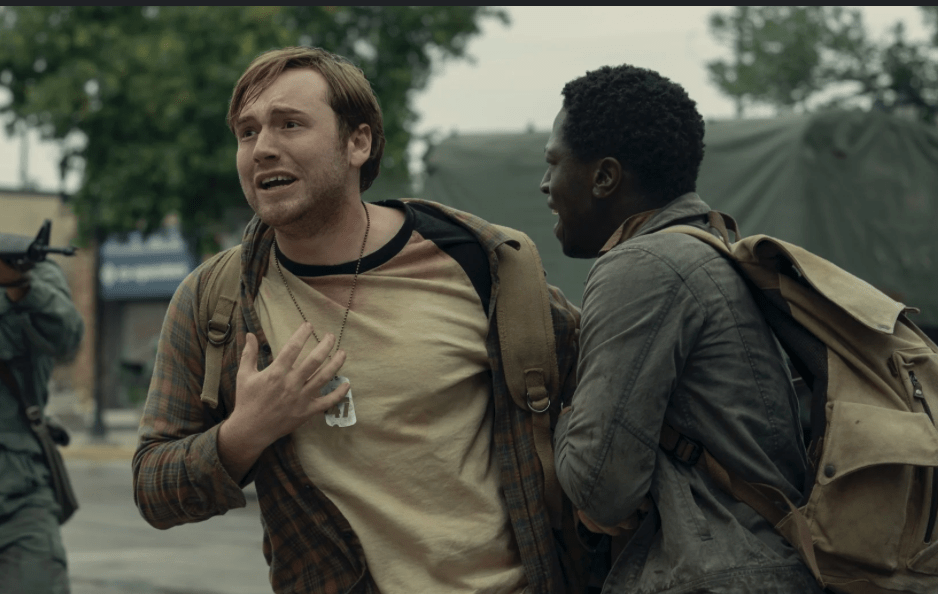
What is most visually striking about The Long Walk’s style is the sense of movement in every frame. The characters never stop moving and neither does the camera, with ceratin scenes having breakneck switches between shot angle and others focusing on longer point-of-view tracking shots. This style creates a sense of immersion, you feel like you are experiencing the Walk in real time.
The original novel was written in the context of the Vietnam draft, however the film’s allegory for how the military industrial complex preys on poor kids remains salient in a post-Iraq War era. As Garraty says, the Walk might be “optional”, but is it really optional if those signing up have no other choice? The film’s overall allegory for the perils of war is mixed through with accompanying themes of the violence (both physical and epistemic) that is carried out under authoritarian nationalism.
There is also a thematic undercurrent in the film of the way violence both creates camaraderie and sows hatred among people.. Though they are unified in a shared struggle, the boys know that only one of them can win at the expense of the other’s lives, causing them to fight and bicker with each other. The Walk turns even the most good-hearted violent and bitter.
While these themes explored by The Long Walk are standard for the teen dystopian genre, the film seems to be re-examining them under the current political climate of on-going conflicts and the rise of the far-right across the globe.
The Long Walk had an uphill battle in creating an engaging film from a story where characters do one single task and where most of the character’s fates are sealed in the opening scene. The film is mostly successful in this goal, using visual style and pacing to keep things moving.
The frequent use of point-of-view shots in the film that works incredibly well in creating novelty and immersion. The film is at its worst when it abruptly abandons the spacial and temporal linearity established in the first two thirds of the plot, in order to do a flashback scene which could have been just as poignant if it was delivered as a line of dialogue. While “show don’t tell” may be a “rule”, doing it at the expense of immersion and consistency is a massive flaw of this film. .
The changes the film makes to the original ending of King’s novel are also quite good as they ad an element of surprise and a new message to the film’s third act. Though the messaging of the film is heavy handed at times, it isn’t to the detriment of the film as a whole.
The film’s comedy is also incredibly well spread out, helping to pace out what would otherwise be a boring and predictable story. It makes you care about these boys before it takes them from you. This is in no doubt due to the incredible performances from Johnsson and Hoffman (as a fan of HBO’s Industry I’ve felt that Johsson was just waiting for his stardom, and I guess its finally his time).
Hamil’s performance is a bit hacky to me, I’m honestly glad he wasn’t in the movie as much as he could’ve been. I think the film understood where its good performances were and luckily stuck with them.
While I think the praises of this film is somewhat inflated, it’s a good movie! Especially among the teen dystopia genre which has been dead for a few years at this point.
 Woodford on Film
Leave a comment